Atlas
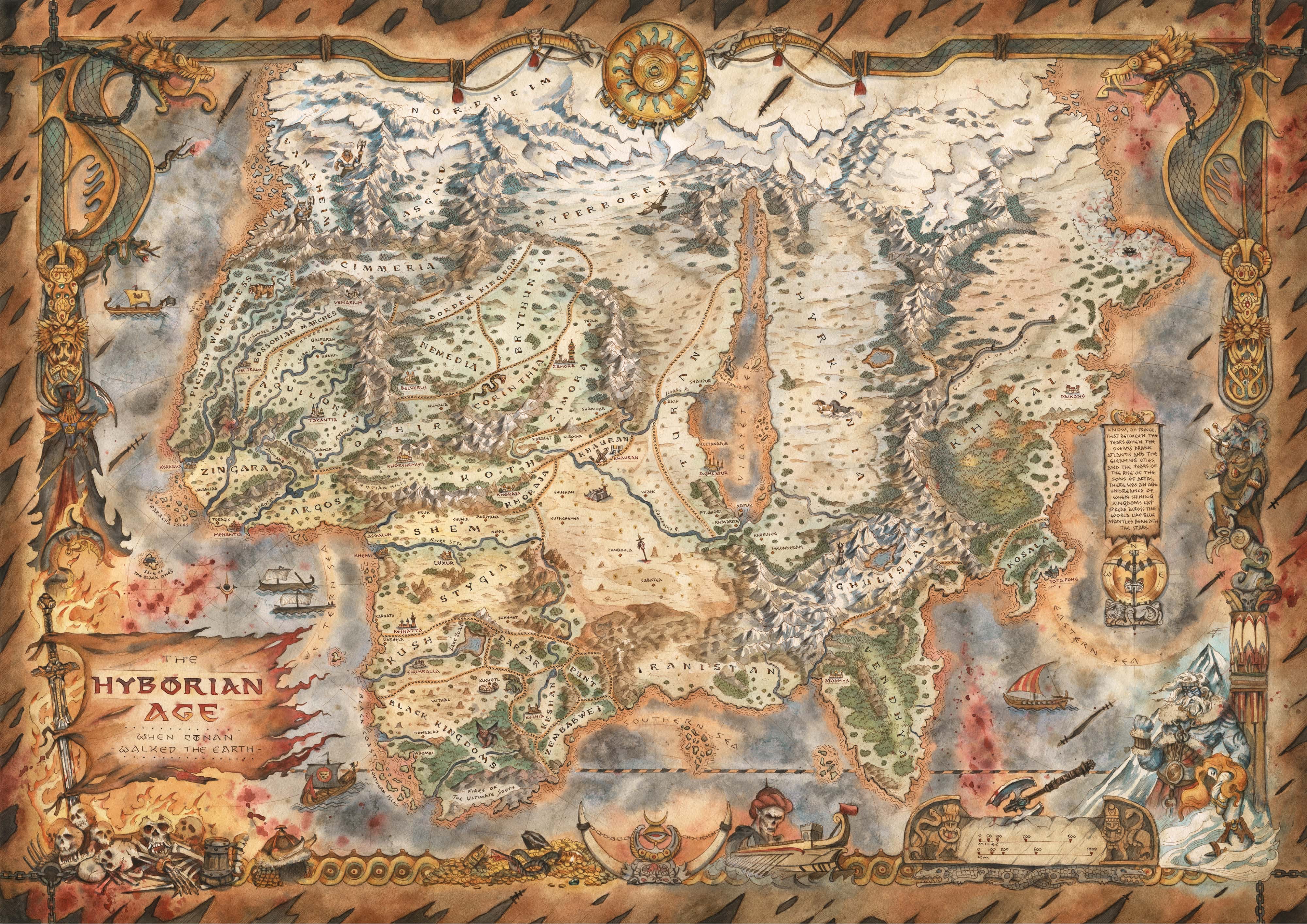
Know, oh prince, that between the years when the oceans drank Atlantis and the gleaming cities, and the years of the rise of the Sons of Aryas, there was an Age undreamed of, when shining kingdoms lay spread across the world like blue mantles beneath the stars – Nemedia, Ophir, Brythunia, Hyperborea, Zamora with its dark-haired women and towers of spider-haunted mystery, Zingara with its chivalry, Koth that bordered on the pastoral lands of Shem, Stygia with its shadow-guarded tombs, Hyrkania whose riders wore steel and silk and gold. But the proudest kingdom of the world was Aquilonia, reigning supreme in the dreaming west.
This page contains only elevator pitches for selected important elements in the lore. Just enough to get you started. For more information, see Resources.
The world
The Hyborian Age is a mythical version of Earth’s past. It takes place some time after the sinking of Atlantis, but long before the beginning of recorded history. In terms of vibes, the world ranges from the Bronze Age up to the Early Middle Ages. It is also a cruel world. It is the stage of war, banditry, blood feuds, executions, slavery, corruption, tyranny, foul sorcery, torture, and widespread social inequity.
The Exiled Lands
The Exiled Lands were once the site of a mighty giant-king empire, but war, disaster, and treachery reduced that empire to ashes and dust. Humans were the slaves of this ancient race, bound into service by serpent bracelets. Now, the bearers of these bracelets are prisoners instead, exiled for crimes committed and unable to leave.
There is something unnatural about the Exiled Lands. The geography is exaggerated and strangely diverse. The very night sky sometimes seems like a more primeval version of itself. Furthermore, the location of the Exiled Lands is deliberately ambiguous, and it may or may not fully exist within the same reality as the rest of the world. Prisoner escorts bring the exiled to the Lands via a long route known to them.
Nations
Below are many nations of the Hyborian Age. This list is not exhaustive.
Black Kingdoms
South of Stygia lie many nations collectively known as the Black Kingdoms. These jungles and grasslands once hosted great civilisations, but now barbarians live in the ruins of a half-forgotten past.
Real-world inspiration: Africa.
Amazon
Amazon is host to a matriarchal and aggressive culture where the women are the valorous warriors, hunters, and rulers, and men are labourers, childcare providers, or mere slaves.
Real-world inspiration: The Dahomey Amazons and Greek Amazons.
Darfar
Darfar is a vast grassland ruled by many small clans. It is most well-known for a subset of the population which obsessively worships Yog, a demonic god whose followers file their teeth and feed on the flesh of men.
Real-world inspiration: Ancient Darfur.
Keshan
Keshan is a nation in decline. Its once-capital Alkmeenon lies in ruins, where now an order of priests deify Yelaya, an ivory-skinned oracle and princess whose body does not rot.
Real-world inspiration: Nubia.
Kush
Kush is a nation of two peoples. The Gallah are the original inhabitants and by far the most numerous. They are tribal hunter-gatherers with a penchant for war. The minority Chaga are the ruling caste descended from conquering Stygian adventurers, who cling to civilisation and worship Set. The two castes are perpetually in tension.
Real-world inspiration: Ancient Kush.
Punt
Punt is a inordinately rich in gold. Great nuggets of gold flow down the mountain streams. Its rulers gather this wealth in their vaults and fund a great army to defend it. The people of Punt worship an ivory goddess.
Real-world inspiration: Ancient Punt.
Tombalku
Tombalku is a confederation of tribes based around the city of the same name. Buried in the southern desert, Tombalku is mythical to most of the world, but for the surrounding nations it is a major commercial centre.
Real-world inspiration: Timbuktu.
Zembabwei
Zembabwei is a hybrid trading empire that is the most urban culture in the Black Kingdoms. It is ruled by twin kings, an arrangement which perhaps represents its twin deities, Derketo and Dagon, whose idols stand proudly outside its capital.
Real-world inspiration: Great Zimbabwe.
Cimmeria
Cimmeria is a mist-shrouded wilderness of dark woods, sombre hills, and grey clouds. Cimmerians are regarded as one of the most barbaric races in the world by Hyborians. Its people are moody and despise weakness.
Real-world inspiration: Gaelic Ireland and Scotland.
Hyboria
Around three millennia ago, the Hyborians began their rise to prominence. They were a rude and barbarous people of the north who worshipped a primitive chieftain-god, Bori. They swept down from the north in a series of migrations, conquering the older kingdoms they encountered and setting up new kingdoms of their own.
Some of the southern Hyborian kingdoms were conquered and ruled by ancient and sinister Acheron, until a new wave of Hyborian barbarians fell upon this empire and shattered its grip upon the land.
More than a millennium ago, the truth of Mitra spread throughout the Hyborian realms, converting most of the populace, with few exceptions.
Today, the Hyborian kingdoms represent the dominant power on Earth, the most culturally and technologically advanced civilisation. There is little that unites the Hyborian peoples except their descent and Mitran faith.
Real-world inspiration: Early-medieval Europe.
Aquilonia
Aquilonia is the wealthiest and most powerful of the Hyborian kingdoms. It is a feudal realm which comprises also Bossonia, Gunderland, Poitain, and Tauran. Aquilonia has a storied rivalry with its neighbour Nemedia. The worship of Mitra is strong in Aquilonia, and the arrogance of its people unparalleled.
Real-world inspiration: Medieval France, late Rome.
Argos
Argos is a nation of master sailors, crafty pirates, and powerful merchant princes. Its navy is the envy of the world. Mitran priests wield much power in Argos, serving as teachers, judges, lawyers, and many other civil function in Argossean society.
Real-world inspiration: Maritime Greece.
Brythunia
Brythunia is a pastoral and agricultural kingdom, where serfs tend to fertile, fecund farms. Life passes by slowly in relative peace, but the nation’s relative lack of defences makes them a target for foreign raiders. Brythunian women are especially prized by slavers for their beauty.
Real-world inspiration: Medieval Poland or Lithuania.
Corinthia
Corinthia is a mountainous land of powerful semi-autonomous city-states. Ancient scholars and philosophers of Corinthia have laid the foundation of all Hyborian learnedness. Vast armies of mercenaries defend this nation at a crossroads.
Real-world inspiration: A mix of ancient and medieval Greece.
Hyperborea
Hyperborea is the first Hyborian kingdom. They live in a bleak and cold land in walled fortress cities. They are noted slavers, and probably the least civilised of the Hyborian kingdoms. The Mitran faith never took root here, and the Hyperboreans worship strange and grim gods—ancestor spirits, monstrous deities, and deified chieftain
Real-world inspiration: Medieval Rus or Novgorod.
Note: See the Clarifications page for additional notes on Hyperborea.
Khauran
Khauran is a small kingdom wrested from Kothic rule by mercenaries and adventurers, ruled by a matriarchal line of nobility.
Real-world inspiration: Medieval Syria.
Khoraja
Khoraja is a fertile meadowland that was originally part of Shem, but was taken at sword-point by Kothic adventurers. It is now proudly independent from Koth, defended by legions of sell-swords.
Real-world inspiration: Outremer.
Koth
Koth is the southernmost Hyborian kingdom which has taken much influence from neighbouring Shem. They have adopted the gods of Shem—particularly Ishtar—and are ruthless slavers. It is an unstable kingdom where princes and barons constantly vie for more power.
Real-world inspiration: The Byzantine Empire and the ancient Near East.
Nemedia
Nemedia is the second-greatest Hyborian kingdom. It is the centre of scholarship and culture in Hyboria. It hosts a small cult of Ibis, banished god of knowledge and enemy of Set.
Real-world inspiration: The Carolingian Empire.
Ophir
Ophir is a tapering wedge between the border of Aquilonia and the vast southern kingdom of Koth. It is a kingdom rich beyond all measure in gold, silver, and in the produce of its diamond mines.
Real-world inspiration: Medieval Sicily or Malta.
Hyrkania and Turan
Hyrkania and Turan are two nations of a single people.
The Hyrkanians are nomadic horsemen, cruel and ruthless, who rampage violently across the steppe. They are riders and archers without equal.
The most prominent Hyrkanian tribe is that of the Turanians, who have carved out a brutal empire of incredibly size for themselves, and they are expanding still. There are innumerable slaves in Turan, afforded no rights at all.
Real-world inspiration: The Turco-Mongol steppe nomads and the Seljuk Turks.
Iranistan
Iranistan is a vast desert country ruled by a caliph. Once it was a far greater nation, but when Hyrkanians settled Turan, the influence of Iranistan waned. It is believed that Ishtar came to Iranistan as a living goddess, visiting prophets in the distance past.
Real-world inspiration: Caliphate Iran.
Khitai
Khitai is a large and ancient nation to the far east shrouded in jungles and ruled by a divine emperor. Little is known of Khitai by Hyborians, for it is an insular nation. Even so, it is a civilisation nearly unparalleled in art, culture, philosophy, and craftsmanship
Real-world inspiration: China.
Nordheim (Asgard & Vanaheim)
In Nordheim one finds two peoples of like blood and language, save that the Æsir of Asgard have yellow hair, and the Vanir of Vanaheim, red hair. Their chief god is Ymir, the frost-giant, and they own no over-lord, but each tribe has its king. They are wild and wayward and fierce. They fight all day and drink ale and roar their wild songs all night. They Vanir and the Æsir are arch-enemies between themselves, fighting constant skirmishes over real and imagined grievances.
Real-world inspiration: Early-medieval Scandinavia.
Pictish Wilderness
The Picts inhabit no true nation, but a vast and untamed wilderness where the only settlements are small villages. The Picts war between themselves just as readily as with white-skinned settlers that encroach upon their territory. They are a savage people of hunters and gatherers with no technology to speak of except the chipping of stone.
Real-world inspiration: The First Nations of North America and the ancient Picts of Scotland.
Shem
Shem is a nation of meadows which host decadent city-states and deserts where roam nomadic tribes. Each city-state has its own king who claims the divine right to rule. Shem is a highly religious nation, and every settlement keeps a temple to at least one of the land’s many gods. It is also a land of merchants and traders, shrewd but honest. Their caravans trade from Vendhya to Aquilonia. The land is guarded by the asshuri, prestigious Shemitish mercenaries.
Real-world inspiration: Ancient Mesopotamia and pre-Islamic Arabia.
Stygia
Stygia is an isolated and dark theocracy greatly feared by external kingdoms. They worship Set, a grim serpent god. The priesthood controls the nation’s bureaucracy, and many priests practise sorcery. With some exceptions, foreigners are not welcome in Stygia. It occasionally sends trade caravans north, carrying processed goods made from materials taken from the lands to its south.
Real-world inspiration: Ancient Egypt.
Note: See the Clarifications page for additional notes on Stygia.
Vendhya
Vendhya is an ancient civilised kingdom, rivalled in the East only by Khitai. Vertical social mobility is impossible in Vendhya; each Vendhyan inherits a caste from their parents that determines their lot in life. The people of Vendhya revere the mystical religion of Asura.
Real-world inspiration: Mughal India.
Yamatai
Yamatai is an island nation east of Khitai.
Real-world inspiration: Yayoi- and Edo-period Japan.
Note: See the Custom lore page for additional notes on Yamatai.
Zamora
Zamora is famed for its absolute debauchery and exceptional thievery. The people of Zamora know many religions, the most well-known among them the spider-worship from the city of Yezud. Anything can be bought and sold in Zamora if the price is right.
Real-world inspiration: Persia, especially Baghdad.
Zingara
Zingara is a maritime trading nation. Its nobility are noted for their skill in swordsmanship, complex code of chivalry, and complex social order which barely hold the nation together. Rival princes threaten to slide the kingdom into all-out civil war.
Real-world inspiration: Reconquista-era Spain.
Religions
There are many religions in the Hyborian Age. Most of them are bound to geography or nations, with relatively few religions existing side-by-side, although some exceptions exist.
Most religion is not organised, with Mitraism and the Setite cult as the most obvious exceptions. This means that there is no common or centralised canonical truth about most religions. Local priesthoods may enforce some understanding of religious law, but there is no universal consensus.
Below are many important religions. The list is not exhaustive.
Asura
Asura is worshipped in Vendhya, and secretively in Aquilonia. Asura, who is time and space, sees through the illusion of the world, which is a wheel. The World Wheel is a two-fold cosmology representing both the journey of the singular, eternal human soul, and the ebbs and tides of human history at large. Asurans believe that the body is a temporary station for a soul, and death is therefore not the end.
Bori
Bori is a chieftain-god of the ancient Hyborians, who saved his people from certain doom after the Cataclysm by leading them on a great conquest southward into present-day Hyboria. He is revered most by Gundermen, Bossonians, and Hyperboreans, and by a minority of Hyborians.
Crom
Crom is the god of Cimmeria. He is a dire god, as gloomy as the Cimmerians themselves. The Cimmerians do not pray to him, nor do they worship him or any of his kind. Crom despises weaklings who call on gods for aid. At birth, however, Crom gives man courage and the will and might to kill his enemies.
Erlik
The Hyrkanians worship a grim, unforgiving god. Erlik is the god of death and sin and disease. He was the first man on earth, created by an older god named Ulgan. But he was imperfect without a soul. When Ulgan created mankind with his own breath, Erlik—in rage and jealousy—taught man how to die. He was cast down by Ulgan to collect and judge the souls of those his act had killed.
Ibis
Ibis is a god of knowledge. Stygians once venerated Ibis as the patron of all forms of lore, from mathematics, astronomy, writing, sciences, and religion, to civil issues such as judgment and laws. He is the judge of the dead and scribe of the gods. However, he was ousted from Stygia, and he now has an abiding hatred of the Serpent who cast him out.
Jhebbal Sag
Jhebbal Sag is an ancient god who once received the worship of all living things, man and beast alike. Today, he is only remembered by the people and beasts of wild places, most notably the Pictish Wilderness. He is the antithesis of civilisation, the antithesis of man living as other than a beast.
Jullah
Jullah is a gorilla-god worshipped in opposition to Set by the Gallah of Kush. Jullah represents the baser instincts of man, such as brutal strength, savagery, frenzy, and uninhibited sexuality. He is also the god of the moon.
Khitai’s cults
The people of Khitai their ancestors and the spirits of the land as their gods. Its jungles, especially, are rich in their spirituality, but they are a dangerous and unhospitable place. Deep within the jungles one may find temples, each dedicated to different gods, spirits or ancestors. But above all, the emperor’s divinity is without question.
Mitra
In the many kingdoms of Hyboria, Mitra is regarded as the truth. He is all-knowing, ever-present, and supreme above all other gods. He wards his faithful against evil, and bids his followers proselytise his truth. His religion cannot tolerate Set, and is known to stamp out the worship of Asura. Priests wishing to progress in the hierarchy advance through seven Mysteries of the faith.
Set
Father Set is the serpent-god of Stygia. He is a dark god who demands blood and human sacrifice. His priests tend to thousands of snakes who slither unmolested through the temples and streets of Stygia. All Stygians must fall to their knees when a snake appears and await the snake to either attack or move on. To be bitten by the snake is to be blessed by Father Set. His priesthood is highly hierarchical and shrouded in mystery and secrets.
Set keeps a hideous, half-bestial pantheon of gods. The most well-known goddess in his pantheon is Derketo.
Shemitish polytheism
The people of Shem know many gods, chief among them Anu and Ishtar. Each city-state has their own patron god and interpretation of the other gods. Many of Shem’s gods have found popularity outside of Shem, particularly in Koth, Corinthia, Khoraja, Khauran, Zamora, and the Black Kingdoms.
Below are some of the most well-known of the gods of Shem.
Adonis
Adonis is a god of fertility and the personnification of primal, sexual attraction. In the warm months, he sees to growth in both field and family. Each winter, Adonis descends into the underworld, and the fields become barren. But with every melt, Adonis returns, and so does life.
Anu
Anu is the god of kings, rarely invoked directly. He is the god of the night sky, and he is believed to have created the universe and the other gods. His roar frightens the heavens into releasing water, bringing forth rain upon the earth. The sun and the moon are said to be his eyes. Anu is worshipped in Corinthia alongside Mitra.
Bel
Bel is the finest of all thieves. He values all the fineries in life. Legend goes that Bel was once a mortal man who stole the most powerful artifacts of the gods, and they were forced to grant him godhood. When the people of Zamora tried to essentially steal the god of theft from Shem, he laughingly went.
Derketo
Derketo, known as Derketa in the Black Kingdoms, is a goddess of fertility, sensuality, and death. She is invoked both at birth and in funerary rites. In Stygia and Shem, the focus is on her erotic side, and she is worshipped via elaborate orgies. In the Black Kingdoms, she is most often worshipped as a goddess of sacrifice and death.
Ishtar
Ishtar is the ivory goddess of love, beauty, fertility, passion, and war. She is identified by the eight-pointed star and by her lions. Petitioners worship Ishtar naked in front of her statue. Ishtar travelled into the underworld to redeem her lover, passing through seven gates and shedding one article of clothing at each until she was nude. Ishtar’s cult has spread far into Hyboria, becoming the main religion of Koth, Khoraja, and Khauran.
Tarim
In Turan, Tarim is worshipped alongside Erlik as a measured and temperate god. He is a god who freed the Lemurian slaves from their masters, and is so known as a liberator and a light-bringer. Tarim teaches that there is within mankind a spark of divinity.
Ymir
Ymir, the frost-giant king of Nordheim, rules from his great hall of Valhalla, peopled by gods and great and worthy warriors. Only in Valhalla do the Vanir and Æsir feast side-by-side, boasting tales of great and glorious deeds. The Nordheimer are eager for this fate, dreading old age or expiry through sickness or disaster.
Yog
Yog is known as the Lord of the Empty Abodes. The Darfari worship Yog by roasting and eating human victims, then immolating their bones. He is said to have dominion over all empty places, such as deserts and the Outer Dark.
Zath
One of the most famous of Zamora’s many gods is the spider-god of Yezud, Zath. His worshippers are spies, assassins, and information brokers who bring knowledge back to the temple in Yezud, that the spider-god may spin its web in the shadows, unfurling silken threads which connect it to the wealthiest and most powerful in the land. Followers of Zath are concerned with purity—they do not drink, gamble or fornicate. They believe that the holy venom of Zath will purify the world and they devote themselves to raising his many children.
Last updated 31 Aug 2026, 08:12 +0200.